
Dr James Muldoon
Author | Academic
James Muldoon is a sociologist whose work explores the human side of artificial intelligence and other technologies. His new book, Love Machines, investigates how people form relationships with AI — as friends, intimate partners, therapists and even with digital versions of deceased loved ones.
He is a Reader (Associate Professor) in Management at the Essex Business School and a Research Associate at the Oxford Internet Institute.
His broader research reveals the hidden human labour and global supply chains that make artificial intelligence possible, and how digital work is transforming sectors from ride-hailing and food delivery to childcare and domestic work.

Subscribe to my newsletter Does not Compute which offers commentary and analysis on artificial intelligence
Email: james.muldoon@essex.ac.uk
Twitter: @james_muldoon_
Agent: Will Francis, Janklow & Nesbit
Love Machines: How Artificial Intelligence is Transforming our Relationships (15 Jan 2026)

‘Urgent, humane.’ The Guardian
‘Existentially chilling’ The Times
‘It’s hard to imagine a timelier book right now than this.’ GQ
As millions of us welcome AI into our daily lives, what does it mean to have a relationship with an artificial companion? Beyond those who are using chatbots for everyday tasks, others are turning to them as friends, mentors and therapists, as well as sexual and romantic partners. Some are men who are preparing to adopt children with their AI partners; others are reaching out to companies offering ‘deathbot’ services based on a deceased loved one’s text messages and voicemails; others still look to therapy bots to find treatment for their mental health issues.
In Love Machines, James Muldoon examines these new forms of love, intimacy and connection, drawing on myriad interviews with users and developers from around the world – as well as psychologists, academics and chatbots themselves. As he navigates these interactions, Muldoon asks whether they might one day be a replacement for the relationships we have with each other, while also revealing how the unregulated corporations facilitating them are seeking to profit from an emerging ‘loneliness economy’.
As the line between the digital and the real becomes increasingly blurred, and in a world that feels lonelier by the day, Love Machines is a timely survey of the next generation of human-computer relationships – and how they are not only changing our relationship with technology, but with each other.
*** The Guardian Book of the Day ***
Extract of Love Machines Published in the Guardian: “Lamar wants to have children with his girlfriend. The problem? She’s entirely AI“
James discusses Love Machines on Sky News
Recent Academic Articles
‘Cruel companionship: How AI companions exploit loneliness and commodify intimacy‘ New Media & Society (2025) (co-author with Jul Parke)
‘Global data empires: Analysing artificial intelligence data annotation in China and the USA‘ Big Data & Society (2025) (co-author with Tongyu Wu and Bing Xia)
‘Racism and food delivery platforms: Shaping migrants’ work experiences and future expectations in the United Kingdom and Chile‘ Ethnic and Racial Studies (2024) (co-author with Macarena Bonhomme)
‘Empowering Digital Democracy‘ Perspectives on Politics (2024) (co-author with Roberta Fischli)
‘A Typology of AI Data Work‘ Big Data & Society (2024) (co-author with Callum Cant, Boxi Wu and Mark Graham)
‘The Poverty of Ethical AI: Impact Sourcing and the AI Supply Chain‘ AI & Society (2023) (co-author with Callum Cant, Funda Ustek and Mark Graham)
‘Artificial Intelligence in the Colonial Matrix of Power‘ Philosophy & Technology (2023) (co-author with Boxi Wu)
‘”Neither work nor Leisure”: Motivations of Microworkers in the United Kingdom across Three Digital Platforms” New Media & Society (2023) (co-author with Paul Apostolidis)
‘Algorithmic Domination in the Gig Economy‘ European Journal of Political Theory (2022) (co-author with Paul Raekstad).
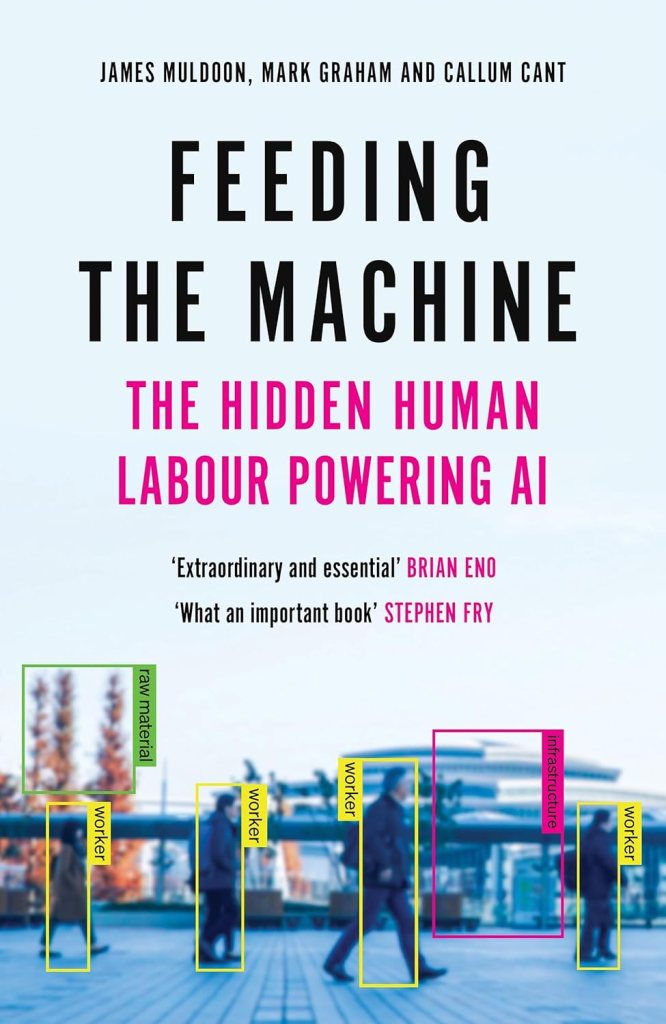
For readers of Naomi Klein and Nicole Perlroth, a myth-dissolving exposé of what ‘artificial intelligence’ really means, and a resounding argument for an equitable future of AI.
Silicon Valley has sold us the illusion that artificial intelligence is a frictionless technology that will bring wealth and prosperity to humanity. But hidden beneath this smooth surface lies the grim reality of a precarious global workforce of millions laboring under often appalling conditions to make AI possible. This book presents an urgent, riveting investigation of the intricate network that maintains this exploitative system, revealing the untold truth of AI.
Based on hundreds of interviews and thousands of hours of fieldwork over more than a decade, Feeding the Machine describes the lives of the workers deliberately concealed from view, and the power structures that determine their future. It gives voice to the people whom AI exploits, from accomplished writers and artists to the armies of data annotators, content moderators and warehouse workers, revealing how their dangerous, low-paid labor is connected to longer histories of gendered, racialized, and colonial exploitation.
AI is an extraction machine that feeds off humanity’s collective effort and intelligence, churning through ever-larger datasets to power its algorithms. This book is a call to arms that details what we need to do to fight for a more just digital future.
LA Times Op/Ed: What’s behind the AI boom? Exploited humans
The Economist: These are the two new books you need to read about AI
Books



My Projects
Platforms without Borders
Investigators
Principal Investigator: James Muldoon
Co-Investigator: Ping Sun
Co-Investigator: Gessuir Pigatto
ESRC New Investigator Grant: ES/W011638/1 (2023-2026)
‘Platforms without Borders’ is a cross-national ethnographic study by a team of researchers based in the United Kingdom, China and Brazil which aims to determine how on-demand labour platforms distribute new opportunities and vulnerabilities for migrant workers in the platform economy. It moves beyond the narrow focus of platform labour studies on a select few cities in the Global North by considering the different circumstances facing migrant workers in three distinct cities and national contexts based on fieldwork in London, Beijing and Sao Paulo with food delivery riders. The international focus provides an opportunity to examine how global platform companies operate differently in distinct regulatory environments, which will deepen our understanding of the platform economy.
The project employs novel ethnographic research methods developed from Paulo Freire’s notion of ‘popular education’ to engage with migrant workers through which workers critically reflect on their own experience of work in dialogue with critical social analysis. The methodology emphasises the importance of workers as active agents with their own distinct understanding of the labour process and the capacity to develop novel solutions to improve their working conditions. By starting from the experience of workers, the project will determine how intersecting regimes of power related to gender, race, class, education and immigration status affect migrant workers’ experience with platform labour. It will examine how broader systems of immigration, welfare and labour market policies operate in different national contexts and how this affects the experience of workers. The research will engage workers with the aim of generating novel policy solutions to the emerging problems of the digital economy.
For early career researchers interested in applying for UKRI funding, please find here my case for support and summary of my successful application for an ESRC New Investigator grant. I hope this is helpful for other applicants.
The Climate Crisis and Democratic Reform
Investigators
Principal Investigator: James Muldoon
Co-Investigator: Clare Saunders
AHRC Networking Grant: AH/Y00132X/1 (2024-2026)
The ongoing threat of the climate crisis poses significant challenges to democratic forms of governance. Responding to the need for immediate action would require swift policy adaptation from governments on a regional, national and international scale. However, democratic governments across the globe have struggled to respond with adequate policies that would prevent global warming above 1.5 degrees celsius as recommended by the IPCC. Scholars have identified several interconnected processes that have hitherto prevented strong action: the influence of fossil fuel corporations on the policy-making process, the short-term orientation of electoral politics, the polarised nature of public debate, the role of representative institutions and the ways in which expert and scientific evidence are used to justify decision-making. Our response to these issues requires further collaboration across disciplinary boundaries to grasp the full implications of the nature of the challenge in the field of democratic governance.
The Climate Crisis and Democratic Reform Network will establish an international group of academic and non-academic experts to pursue new lines of inquiry into how climate change is impacting democratic governance and which reforms are necessary to adequately respond to this emerging challenge. This involves interdisciplinary collaboration across political philosophy, law, democratic theory, environmental politics and energy policy. The aim of the network is to produce a theoretically rigorous understanding of democracy in an age of climate crisis and to examine institutional designs that could reform how democracy operates. The network will develop novel justifications for the value of democracy in light of the climate emergency to strengthen commitments to democratic forms of government when faced with these new challenges. The network has the further goal of building relationships between academics and civil society groups. It will provide opportunities for new connections to be formed between different communities of scholars and practitioners that will enable knowledge exchange to take place on the issues of climate change and democratic reform.
 James Muldoon